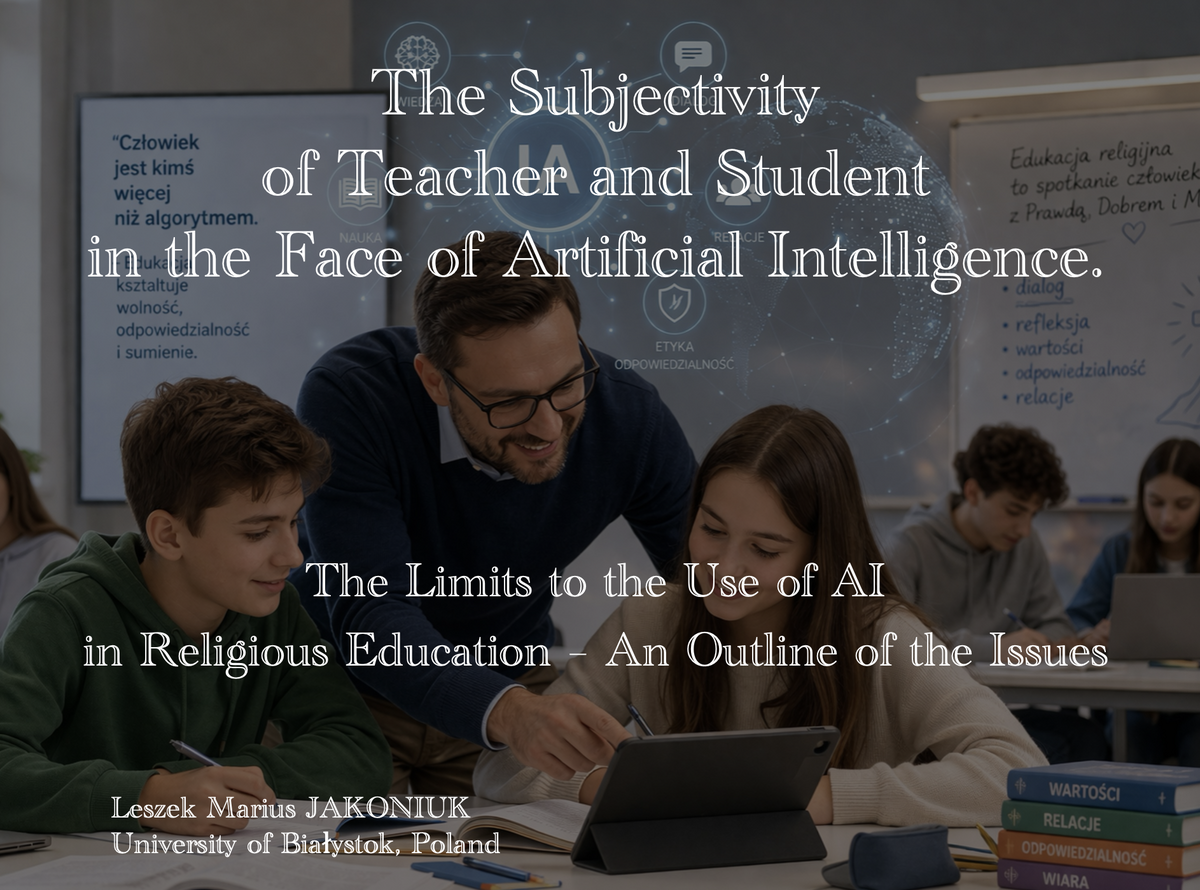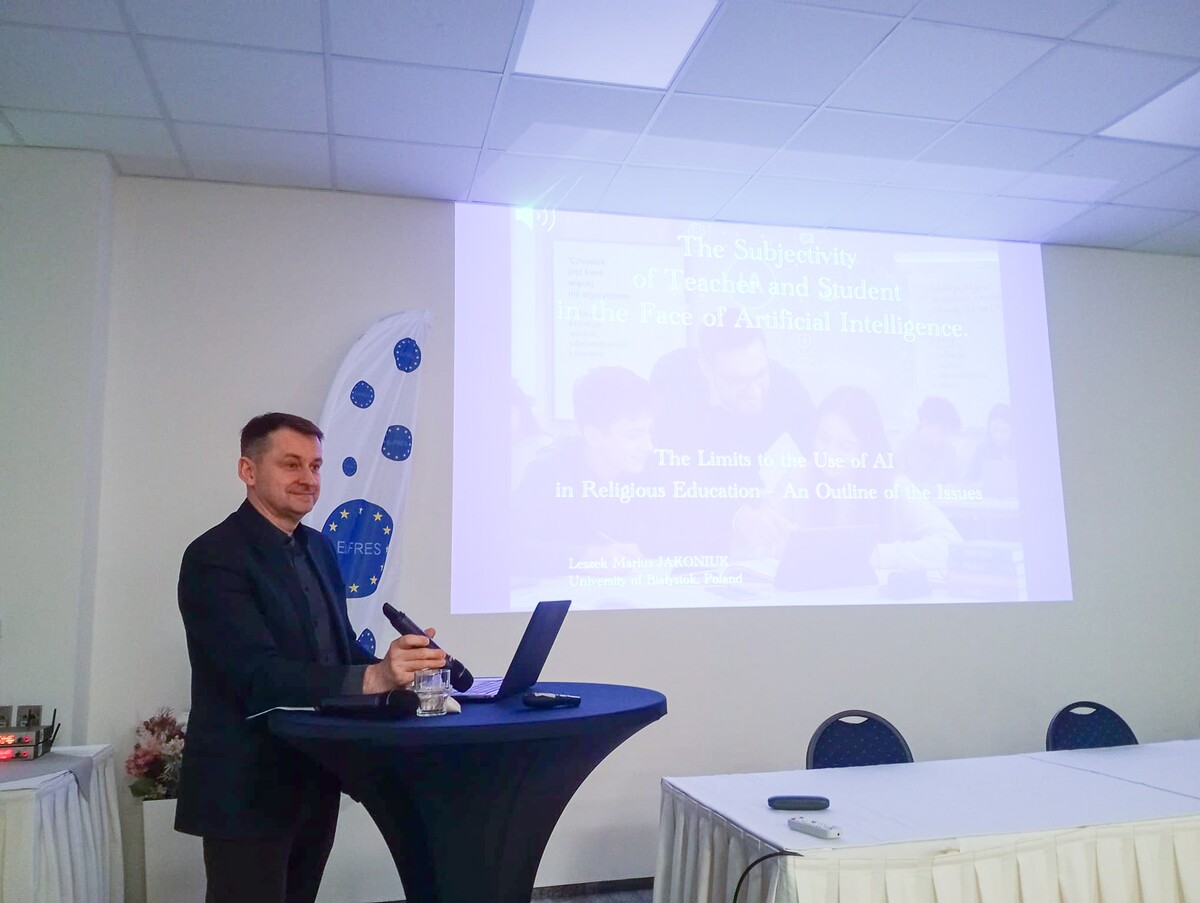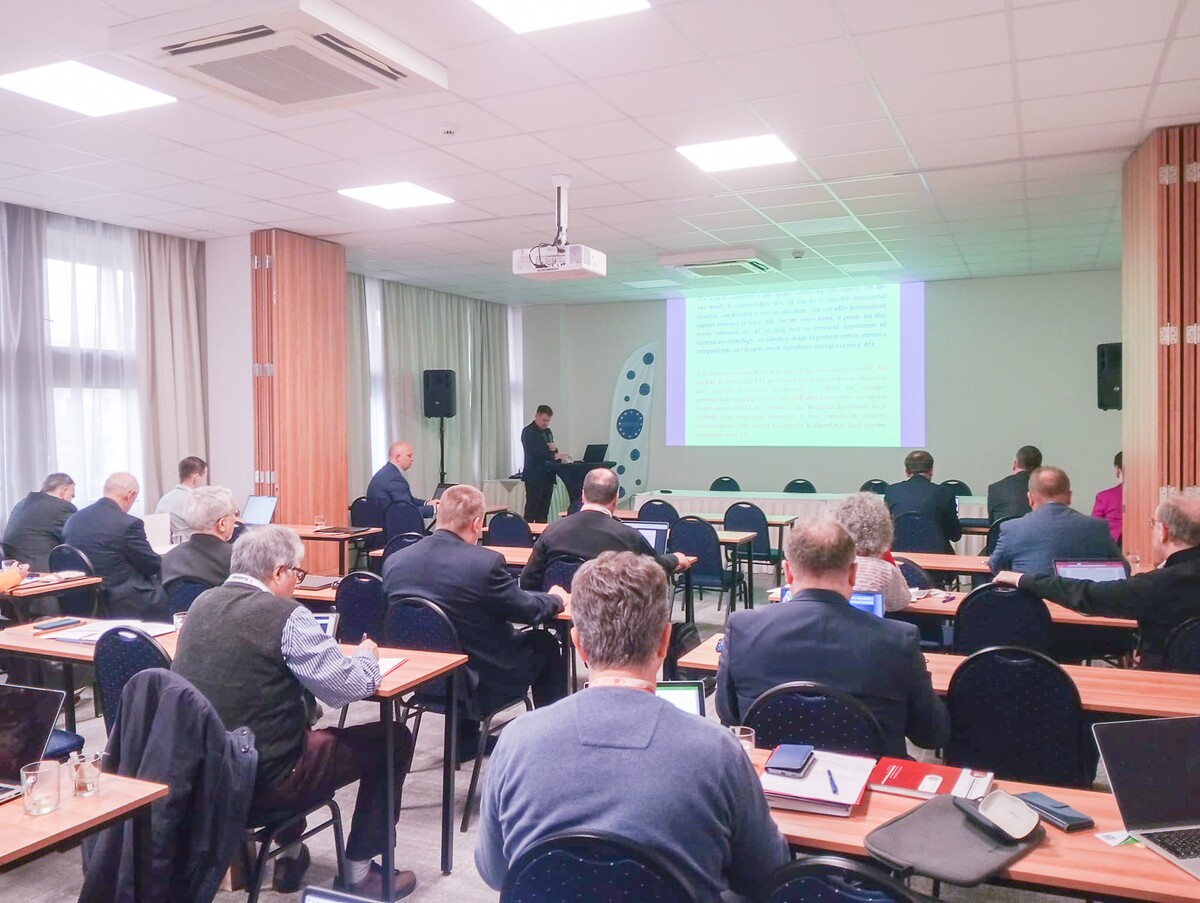
From 8 to 12 April 2026, Prague hosted the European Forum for Religious Education in Schools. The event was attended by Rev. Leszek Marius Jakoniuk, a staff member of the Chair of Catholic Theology at the University of Białystok, who delivered a plenary lecture in French entitled: “The Subjectivity of Teacher and Student in the Face of Artificial Intelligence. The Limits of the Use of AI in Religious Education – An Outline of the Issues”.
In his presentation, he reflected on the place of artificial intelligence in religious education, emphasizing that it cannot be reduced merely to a form of technical support for the teaching process. The key question concerns the extent to which the development of AI affects the subjectivity of both teacher and student, and whether technology genuinely serves the integral development of the human person or, instead, risks weakening that subjectivity. The lecture stressed that religious education is not limited to the transmission of knowledge, but also includes the formation of conscience, freedom, responsibility, and the ability to make mature choices. For this reason, the teacher–student relationship remains the foundation of the educational process and cannot be replaced by technological tools.
The lecture further highlighted that the religion teacher is not only a specialist communicating content, but also a witness, a guide, and a person responsible for both the word spoken and the educational relationship itself. Artificial intelligence may generate accurate answers and simulate dialogue; however, it possesses neither conscience, nor moral responsibility, nor authentic personal presence, and therefore cannot take the place of the teacher in the process of education. The speaker also underlined that the student cannot be regarded merely as a system user or as a recipient of algorithmically structured content. The student is a person capable of reflection, interpretation, choice, and inner growth. In this context, AI can be useful only insofar as it supports independent thinking and responsible discernment, rather than replacing the student in the search for meaning and answers.
In conclusion, it was noted that artificial intelligence may serve as a valuable auxiliary tool in the preparation of teaching materials, the organization of content, and the individualization of instruction. Its use, however, must always remain subordinate to the person, to relationships, and to the aims of education. The lecture clearly emphasized that, in religious education, the human person must remain at the center, because, as recalled after the pedagogue Prof. Kazimierz Twardowski, “only a human being can educate another human being”.
The next international conference organized within the framework of EuFRES has been announced for 2028 in Madrid.