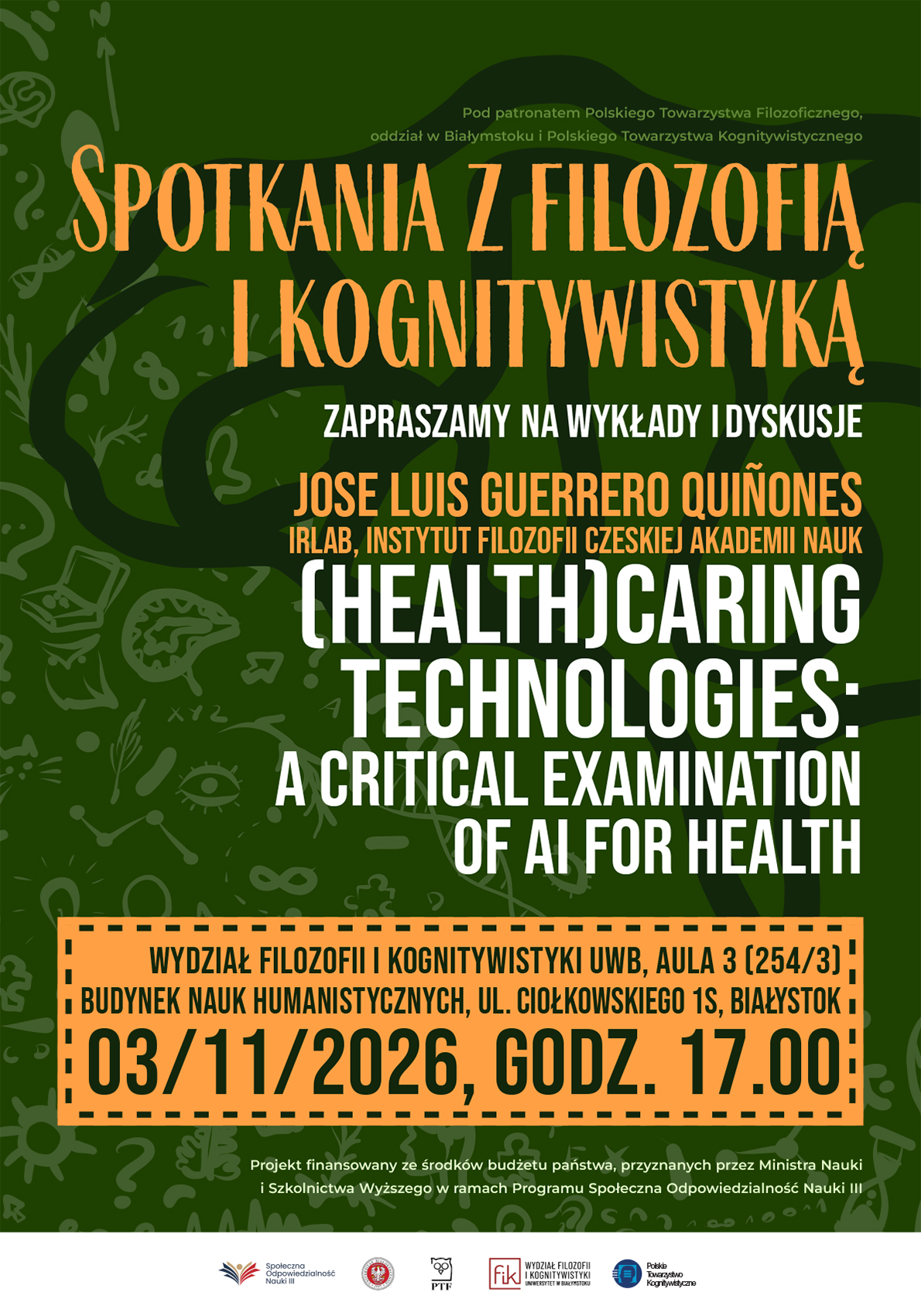
Czy technologie AI w medycynie rzeczywiście „troszczą się” o zdrowie? Jakie założenia kryją się za obietnicą, że algorytmy poprawią opiekę nad pacjentami? Gościem najbliższego spotkania (wtorek, 3 listopada, budynek nauk humanistycznych, g. 17:00, aula 3 (254/3) będzie Jose Luis Guerrero Quiñones z Instytutu Filozofii Czeskiej Akademii Nauk, który wygłosi wykład na temat: "(Health)caring technologies: a critical examination of AI for health".
Spotkanie odbędzie się w ramach programu "Społeczna Odpowiedzialność Nauki III" współfinansowanego przez Ministerstwo Nauki i Szkolnictwa Wyższego.
Teaser: Artificial intelligence (AI) is everywhere. It promises to make us more efficient, productive, and healthier. You might have concerns regarding the first two, but clearly see nothing wrong with being healthier, how could one be against that? The lecture explores how AI reproduces a narrow understanding of health that focuses on the individual and overlooks structural causes of poor health. The problematic consequences of this conception will be analysed and a different model for designing (health)caring technologies will be proposed.
Abstrakt: Healthcare is one of the domains where artificial intelligence (AI) offers great promises and seemingly undeniable benefits for our quality of life, and thus it is often portrayed as a technology whose use should be obligatory from an ethical perspective. The implications of this inevitability of AI for health purposes are twofold.
First, at the individual level, the rapid advances in AI-powered technologies contribute to the gathering and processing of millions of data points reflecting our health, which can be used to design more personalised plans that assist individuals in pursuing a healthier lifestyle. The result is a narrow conception of health that focuses on quantifiable data that can be analysed to generate a model of a healthy subject, who is, consequently, obsessed with optimising each of the variables that contribute to their health. This reflects the current predominance of health consciousness in society, and with it the preoccupation to live according to the mandates of a specific lifestyle that promises to bring health, making us live better and longer. I will examine how technology delimits and prescribes specific concepts of health and well-being, being especially attentive to how AI exacerbates a quantified and reductive (self)interpretation of the individual.
Second, at the structural level, the use of AI in healthcare exacerbates and reproduces health injustices. The promises of AI do not seem to apply to all equally. I will take the knowledge and experiences of marginalised social groups as the starting point for thinking about (health)care, and thereby technologies in this setting, differently. From there, we can think of developing alternative paths to co-designing health technologies that aim to transform dominant socioeconomic structures and support collective conceptions of well-being. I will suggest that new socio-technical structures should be constructed based on horizontality and community autonomy, where there is direct democratic control of the design, development, and implementation process of health-promoting technologies. It is crucially important to let the people decide horizontally what their (health)care needs are, based on their circumstances, the structural injustices they face, and the social and environmental factors determining their health. I will conclude arguing for the refusal to AI in healthcare contexts when these technologies fail to meet the requisites of convivial (health)caring tools.